Cat Flap Advice — How to Choose the Right Cat Flap in 2026
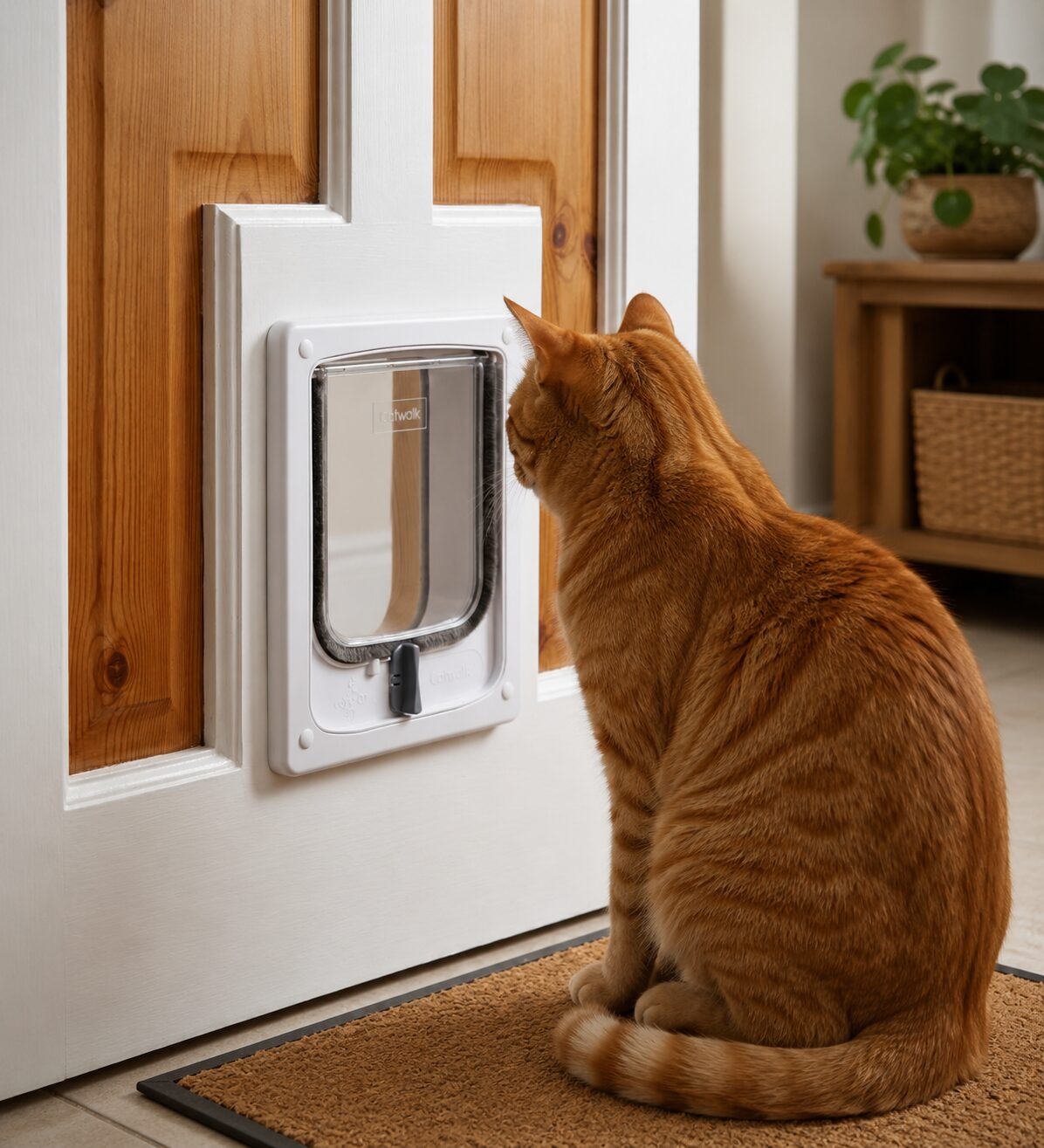
Walk into any hardware store and you'll find a shelf full of cat flaps. Walk onto any glazing supplier's website and you'll find dozens more. The problem isn't choice; it's knowing what actually matters. This guide cuts through the noise and explains exactly what a cat flap is, what the key differences are between types, and how to choose the right one for your cat and your home in 2026.
- The two most important decisions are installation type (glass fitting vs wood fitting) and whether you need selective entry; everything else follows from those two choices.
- A quality cat flap needs four things: rigid polycarbonate flap, brush seals on all four sides, magnetic closure, and a 4-way manual lock. Without all four, you'll have drafts, rattling, or security problems.
- Pet-Tek's Catwalk® range covers glass panels from 3mm to 28mm and door panels from 11mm to 52mm, with battery-free multi-magnetic selective entry available in both configurations.
What Is a Cat Flap?
A cat flap (also called a cat door or cat door flap) is a small opening fitted into a door, wall, or glass panel that allows a cat to pass through independently without needing a human to open the door. The flap swings open when pushed by the cat and closes again automatically.
Modern cat flaps are significantly more sophisticated than the simple hinged holes of previous decades. Today's best models use UV-stabilised polycarbonate flaps, brush seals, magnetic closures, and selective entry systems. According to Cats Protection UK, a well-chosen cat flap significantly reduces territorial stress by giving cats reliable independent access to outdoor space.
The Main Types of Cat Flap in 2026
There are three main types of cat flap available, each suited to different situations, budgets, and requirements:
| Type | How It Works | Best For | Selective Entry | Battery Required |
|---|---|---|---|---|
| Standard manual flap | Push-through flap with manual 4-way lock | Single cat households, basic access control | ✗ No | ✗ No |
| Multi-magnetic | Collar magnet releases mechanical lock | Keeping stray cats and wildlife out | ✓ Yes | ✓ No (battery free) |
| Microchip / RFID | Scans cat's implanted microchip or RFID collar tag to unlock electronically | No collar needed (microchip) or collar-based (RFID), tech-focused owners | ✓ Yes | ✗ Yes (batteries required) |
Pet-Tek designs and manufactures the standard manual flap and multi-magnetic options in both glass fitting and wood fitting configurations. Pet-Tek does not make microchip/RFID doors. The key advantage of multi-magnetic over microchip is zero battery dependency: the mechanism is purely mechanical and will never fail due to flat batteries or sensor malfunction.
Cat Flap Comparison — Pet-Tek vs Other Brands
Not all cat flaps are made equal. Here's how the Catwalk® range compares to other brands commonly available in 2026:
| Feature | Pet-Tek Catwalk® | Budget brands | Microchip brands |
|---|---|---|---|
| Flap material | UV-stabilised polycarbonate | Thin flexible plastic | Varies, often ABS |
| Brush seals | ✓ All four sides | ✗ Rarely included | Partial, 2 sides typical |
| 4-way locking | ✓ Standard on every model | 2-way or none | ✓ Most models |
| Magnetic closure | ✓ Yes | ✗ Rarely | ✓ Electronic |
| Battery required | ✓ No, never | ✓ No | ✗ Yes, regular replacement |
| Glass fitting option | ✓ 3–28mm | ✗ Rarely available | Limited models |
| UV resistant | ✓ UV-stabilised | ✗ Yellows and cracks | Varies |
| Cut-out profile | Round, lower risk for glaziers | Rectangular | Rectangular |
| Warranty | 3 years* | 1 year or none | Up to 3 years |
Glass Fitting vs Wood Fitting — Which Do You Need?
Before choosing a specific model the most important decision is where the cat flap will be installed.
Glass Fitting Cat Flap
- Installs directly into a glass panel
- Requires a glazier to cut a round hole
- Suits single glazing, double glazing, ranch sliders
- Glass panels 3mm to 28mm thick
- Clean flush finish, no visible housing
- Most popular for NZ and Australian homes with sliding glass doors
- View all glass fitting cat doors →
Wood Fitting Cat Flap
- Installs through a timber, PVC or composite door
- Can be DIY installed with basic tools
- Suits panels 11mm to 52mm thick
- Self-lining tunnel closes up to panel thickness
- No glazier required; most installs under 60 minutes
- Slimline and tunnel versions available
- View all wood fitting cat doors →
What Makes a Good Cat Flap — The Features That Matter
Flap Material
The flap itself is the most important component. Cheap cat flaps use thin, flexible plastic that warps under UV, rattles in wind, and degrades rapidly. Quality cat flaps use rigid UV-stabilised polycarbonate that won't yellow, crack, or warp, even after years of daily use in harsh sunlight. Two of the checks come straight from our tooling room: look for a flap that sits in its body at next to zero tolerance under a full brush seal, and a body whose internal draft angles let driven rain drain out instead of pooling. The first decides how draughty the flap is; the second decides what it looks like in year five.
Brush Seals
Brush seals line the flap opening and trap air to prevent drafts. A cat flap without brush seals is essentially a permanent hole in your wall. All Pet-Tek Catwalk® models include dense brush seals on all four sides of the flap opening.
Magnetic Closure
A magnetic closure pulls the flap firmly shut after each use, ensuring it seats fully against the brush seals. Without magnetic closure, flaps can sit slightly ajar in wind, letting in cold air and noise.
4-Way Manual Lock
A 4-way lock gives you full control: open both ways, in only, out only, or fully locked. This is essential for keeping your cat in overnight, controlling access during bad weather, or fully securing the door when you're away.
UV Resistance
In New Zealand, Australia, South Africa, and the Middle East, UV exposure is a major factor in cat flap degradation. UV-stabilised polycarbonate retains its clarity and structural integrity for years; many Pet-Tek customers report their Catwalk® cat doors still performing perfectly after 10+ years.
Not sure which cat flap is right for your home? Use our interactive size guide to find the perfect Catwalk® model for your cat and your door type. Find My Cat Flap →
The Pet-Tek Catwalk® Range — Models at a Glance
The Catwalk® range covers glass fitting, wood fitting and multi-magnetic options across multiple sizes and colours. All models include brush seals, magnetic closure, 4-way locking, and a 3-year manufacturer's warranty*.
| Model | Type | Glass / Panel | Selective Entry | Colours |
|---|---|---|---|---|
| G-CDC / G-CDW | Glass fitting, original | 3–10mm | ✗ | Clear / White |
| G-MCDW | Glass fitting, multi-magnetic | 3–26mm | ✓ | White |
| G-SDDSLC / G-SDDSLW | Glass fitting, maxi slim line | 3–21mm | ✗ | Clear / White |
| G-SDDC / G-SDDW / G-SDDB | Glass fitting, maxi dual glaze | 3–28mm | ✗ | Clear / White / Black |
| W-CDW / W-CDB | Wood fitting, slim line | 11–30mm | ✗ | White / Brown |
| W-CDTW / W-CDTB | Wood fitting, tunnel | 11–52mm | ✗ | White / Brown |
| W-MCDW / W-MCDB | Wood fitting, multi-magnetic | 11–52mm | ✓ | White / Brown |
Common Cat Flap Problems, and How to Avoid Them
- Cat won't use the flap: usually a size issue (too small) or a material issue (flexible flap feels strange on their back). Rigid polycarbonate flaps are much better accepted by cats than soft vinyl flaps. See our size guide to check your measurements.
- Drafts and rattling: caused by no brush seals, no magnetic closure, or a warped flap. All three are solved by choosing a quality model with proper sealing. See our guide to keeping your home warm with a pet door.
- Other cats getting in: the only permanent solution is a multi-magnetic cat door. Manual locking only works when you are home to manage it. Read our full guide on how to stop other cats coming through your cat door.
- Flap yellowing or cracking: caused by UV degradation of cheap plastic. UV-stabilised polycarbonate does not yellow or crack, even after 10+ years in harsh sunlight.
- Poor fit in double glazing: always check the glass thickness compatibility before purchasing. Pet-Tek dual glaze models handle glass from 3–28mm. See our best glass fitting cat doors guide for full details.
- Replacement parts unavailable: many brands discontinue spare parts when models change. Pet-Tek stocks replacement flaps, locking dials, magnets, and seals for all current models, including models manufactured 20+ years ago.
How to Choose the Right Cat Flap — Step by Step
Follow these three steps to narrow down the right model for your home:
- Where is it going? Glass panel (ranch slider, patio door, window) → you need a glass fitting cat door, installed by a glazier. Wooden, PVC, or composite door → you need a wood fitting cat door, DIY-friendly. Wall installation → a wood fitting model fitted to a lined tunnel built through the wall; contact us with your wall thickness.
- Do you need selective entry? If neighbourhood cats, possums, or wildlife are entering your home, choose a multi-magnetic model. If not, a standard model with 4-way locking gives you full manual control.
- Measure your cat. Widest point and body depth (top of the back to the bottom of the chest) while standing, add 25mm to each: that is the minimum usable opening. As a guide, cats up to about 7kg suit the original Catwalk® cat door (165×180mm usable opening) and cats of 7–10kg the Maxi (187×190mm). Use the Pet-Tek door finder for an instant model recommendation.
Frequently Asked Questions
Find the right cat flap for your home
Use our interactive size guide: enter your cat's weight and door type and we'll recommend the exact right Catwalk® model for your home.
Find My Cat Flap →