Why glaziers prefer round cut-out pet doors, and why it matters for your installation business
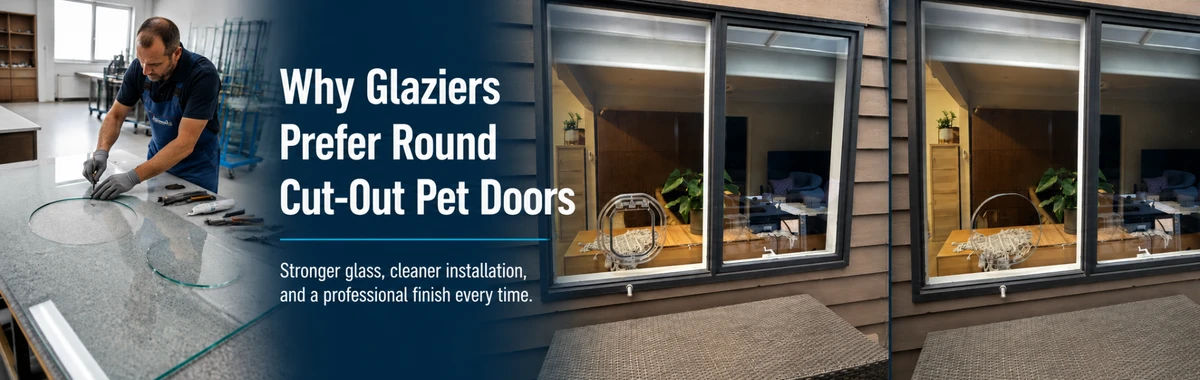
If you install glass fitting pet doors professionally, the shape of the cut-out is not a minor detail; it directly affects your installation time, your callbacks and your glass breakage risk. Pet-Tek has manufactured glass fitting pet doors with a round cut-out since 1999. This guide explains exactly why glaziers and pet door installers across the UK, Australia, New Zealand, South Africa and the USA consistently choose round over rectangular, and what it means for your business.
- Round cut-outs distribute stress evenly across the glass, while rectangular cut-outs concentrate stress at corners, increasing breakage risk.
- A round hole drilled by a glazier is faster and more consistent than a rectangular cut using multiple tools.
- Pet-Tek's round cut-out design has been the preferred choice of glaziers and window manufacturers in 20+ countries since 1999.
- All Pet-Tek glass fitting cat doors and dog doors use a single round cut-out: no corners, no stress points, fewer callbacks.
- OEM and white-label supply is available for trade buyers wanting their own branded product.
Round vs rectangular cut-out — what is the difference?
Pet doors installed into glass panels require a hole to be cut through the glass. That hole is either round (circular) or rectangular. The shape is determined by the pet door manufacturer's design, and it has significant consequences for the glazier doing the installation.
Rectangular cut-outs require four straight cuts with sharp 90-degree corners. Round cut-outs require a single core drill. The difference in time, risk and professional outcome is substantial, and it is why Pet-Tek designed its entire glass fitting range around a round cut-out from the beginning.
Why round cut-outs are safer for glass
Glass is a brittle material. When stress is applied to a flat panel (from temperature changes, wind load or the daily impact of a pet pushing through a flap) that stress travels through the glass and concentrates at the sharpest points it can find.
A rectangular cut-out has four 90-degree corners. Each corner is a stress concentration point. Over time, or during installation, cracks initiate at corners and propagate outward through the panel. This is basic materials science, and it is why structural engineers avoid square holes in load-bearing panels wherever possible.
A round hole has no corners. Stress distributes evenly around the full circumference of the opening. The result is a more stable installation that is less likely to crack during drilling, less likely to fail during installation and less likely to generate a warranty callback months later.
| Factor | Round cut-out | Rectangular cut-out |
|---|---|---|
| Stress distribution | ✔ Even: no concentration points | ✘ Concentrated at 4 corners |
| Breakage risk during drilling | ✔ Low: single core drill | ✘ Higher: multiple cuts required |
| Cracking over time | ✔ Minimal: no corner stress points | ✘ Corners can initiate cracks |
| Installation tools required | ✔ Core drill only | ✘ Multiple: saw, grinder, router |
| Installation time | ✔ Faster | ✘ Slower |
| Finish quality | ✔ Clean, consistent edge | ✘ Corner finish requires care |
| Suitability for double glazing | ✔ Factory pre-cut is straightforward | ✘ Corner pre-cuts are more complex |
Faster installation means more jobs per day
For a glazing company or pet door installer, time on site is direct cost. A round cut-out requires one tool, a core drill of the correct diameter, and a single drilling operation. The hole is done. The pet door drops in, locks with two screws and the job is complete.
A rectangular cut-out requires marking out four straight lines, cutting four sides, managing the corners, either by drilling pilot holes at each corner first or by grinding them out after the straight cuts are made, and finishing the edges. That is a multi-step process with more margin for error and more time on site.
Trade insight: Glaziers who switch from rectangular to round cut-out pet doors consistently report faster installation times and fewer glass panels broken during the cutting process. Fewer broken panels means lower material costs and fewer return visits, directly improving job profitability.
Pet-Tek glass fitting pet doors — the round cut-out system built for glaziers since 1999
Pet-Tek International was founded in 1999 by a team with deep roots in the glazing industry. The round cut-out design was not an accident; it was a deliberate engineering decision made specifically to make life easier for professional glaziers and window manufacturers. The same tooling discipline runs through the body itself: draft angles are set so water drains out of the installed door rather than accumulating inside it, and the flap runs at next to zero tolerance behind a full brush seal. Fewer moisture and draught complaints for your customer means fewer callbacks for you.
Every glass fitting Catwalk® cat door and Dogwalk® dog door in the Pet-Tek range uses a round cut-out. Models are available for glass thicknesses from 3mm to 32mm, covering single glazing, double glazing, ranch sliders, UPVC patio doors and most sliding glass doors. The pet door slots into the round hole and is secured cleanly with minimal fixings. No secondary frame, no sealant mess, no complicated finishing.
| Product range | Cut-out type | Glass thickness | Pet size |
|---|---|---|---|
| Catwalk® glass fitting cat doors | Round | 3mm – 28mm | Cats & small animals |
| Dogwalk® glass fitting dog doors | Round | 3mm – 32mm | Small to semi-large dogs (Intermediate & Medium) |
| Catwalk® multi-magnetic cat doors | Round | 3mm – 26mm | Cats, selective entry |
Double glazing — why round makes factory pre-cutting easier
Double glazed glass cannot be drilled on site after toughening; the hole must be pre-cut during manufacture, before the unit is sealed and toughened. This means the glass manufacturer needs to cut the hole in the raw glass at the factory, then toughen the panel with the hole already in place.
A round hole is straightforward to cut and toughen at the factory. The process is clean and consistent. A rectangular hole introduces corner geometry that requires additional care during toughening, as corners remain the weakest point even in toughened glass.
For glazing companies who order pre-cut double glazed units for pet door installations, specifying a round cut-out makes the factory process more reliable and the finished unit stronger. It is one of the reasons Pet-Tek is the preferred supply partner for window manufacturers across the UK, Australia, Japan and South Africa.
Fewer callbacks — better margins for your business
Every callback costs a glazing business time and money: travel, labour, possibly a replacement glass panel. The two most common sources of pet door callbacks are cracked glass and flap failure. Pet-Tek's round cut-out design addresses the glass cracking risk directly. The high-impact UV-stabilised polycarbonate flap, with a high-swing mechanism that reduces hinge stress, addressing flap failure.
The result is an installation that lasts. Pet-Tek carries a 3-year manufacturer's warranty* on all products, and many installations from the early 2000s are still in daily use. For a glazing company, this means fewer warranty claims, fewer return visits and better customer retention.
Supply Pet-Tek to your glazing customers
Pet-Tek International supplies glass fitting pet doors wholesale to glazing companies, window manufacturers and pet door installers across the UK, Australia, New Zealand, South Africa, the USA and 15+ other countries. Request our trade catalogue or apply to become a distributor.
Request trade catalogue →